For well over four years, Chan Sung Jung, the two-time UFC featherweight title contender better known as ‘The Korean Zombie,’ leaned on one voice above all others in his corner. That voice suddenly went silent on Tuesday, November 24, and the UFC veteran is still struggling to come to terms with the loss. According to him, it has hit harder than any defeat inside the Octagon.
On Tuesday, the famed striking coach Eddie Cha passed away at the age of 53. His untimely death rocked the combat sports world, as he had spent years helping develop UFC champions and contenders. Former UFC fighter Michael Chiesa first shared the news, while MMA journalist Ariel Helwani subsequently reported that Cha had suffered a sudden heart attack. Although the reported cause has not been officially confirmed, his passing has understandably left many distraught. But it seems to have hit Jung, his longtime pupil, particularly hard.
“I can really feel it when I come to Coach’s house,” Jung wrote on Instagram. “I loved Coach so much, really. I miss you so much. I keep crying. Coach, you lived a good life, in a good place, a comfortable place. I hope you go to a good place, a comfortable place, and I will definitely meet you again, and I will wait for that day. I love you so much, my friend.”
It is understandable why the 39-year-old would be inconsolable after Eddie Cha’s passing. The bond between the two wasn’t built overnight.
Cha came into Jung’s life after one of the most painful defeats of his career, and the relationship eventually grew into something much bigger than a fighter and his coach. Following Jung’s devastating last-second knockout loss to Yair Rodriguez in November 2018, the Korean joined Cha’s famed Fight Ready MMA gym in 2019 and began working closely with the veteran coach.
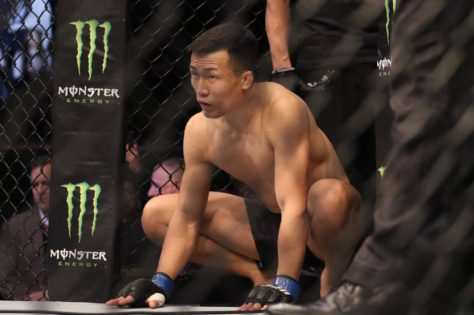
Jung later reflected that the defeat was fate, believing that it had ultimately led him to the right people and a different approach to his training. Cha helped him become more patient inside the Octagon rather than relying solely on the aggressive instincts that had earned him the nickname ‘The Korean Zombie.’ The change soon showed in his performances.
Jung returned to the Octagon in June 2019 and stopped Renato Moicano in just 58 seconds. He followed that up with another first-round finish against former UFC lightweight champion Frankie Edgar at UFC Busan in December. The two victories put him back in the featherweight title conversation, but Cha’s commitment to his fighter went well beyond helping him prepare for fight night.
When the COVID-19 pandemic disrupted training and travel arrangements in 2020, Cha himself travelled to South Korea to help Jung put together a good training camp ahead of his October matchup against Brian Ortega. It was another example of how far the coach was willing to go for his fighters, and it further strengthened a relationship that would continue through the biggest moments of Jung’s career and even after.
The Korean Zombie eventually earned his second opportunity to become UFC featherweight champion against Alexander Volkanovski at UFC 273 in April 2022. However, the Australian proved too much for him, stopping Jung in the fourth round. He returned in August 2023 to face former champion Max Holloway, but suffered another knockout loss in the third round.
This time, Jung decided he had fought enough.
He left his gloves in the center of the Octagon in Singapore to announce his retirement before sharing an emotional embrace with Eddie Cha. The coach had been there through the highs, the setbacks and the end of his fighting career. That final moment now carries even greater significance following Cha’s passing.
But Jung wasn’t the only UFC fighter who had a difficult time accepting the news.
Another one of his students, Henry Cejudo also took to social media to remember the coach who had played a major role in transforming his career from that of an Olympic wrestler into a two-division UFC champion.
“This one really hurts. I’m still in shock of what happened. Eddie Cha was a good man, good friend, good husband, good coach, but most importantly, a great friend,” Cejudo wrote. “To all the great times we spent together, won and even cried. You’ve made an impact in my life, Coach, and I will forever be grateful. It hurts me that you’re gone, but I can feel your spirit. Rest in peace, Master Eddie Cha.”
Cejudo’s tribute carries its own significance because Cha was part of the coaching team that helped him develop the striking needed to compete with the best in the UFC. Working alongside Santino DeFranco and Eric Albarracin, Cha became Cejudo’s primary striking coach and mitt holder during his transition from freestyle wrestling to MMA.
Rather than simply making Cejudo faster or more powerful, Cha focused on distance, timing and movement. One of the systems they developed was the “Tic Tok” rhythm, which allowed Cejudo to shift his weight, load his shoulders and create openings for hooks and head kicks while keeping his wrestling game ready.
The results were difficult to ignore.
Cejudo dethroned Demetrious Johnson to win the UFC flyweight title in 2018 before stopping T.J. Dillashaw in just 32 seconds in 2019. He then captured the vacant bantamweight title against Marlon Moraes and defended it against former champion Dominick Cruz at UFC 249 in 2020. Cha was part of the coaching team behind those achievements, making him one of the people Cejudo had every reason to remember so fondly.
How Eddie Cha built champions at Fight Ready MMA
Cejudo and Jung were only two of the many fighters whose careers were shaped by Cha. But his journey to becoming one of the most respected striking coaches in MMA began long before he became a familiar face in UFC corners.
Born in South Korea in 1973, Cha moved to California with his family when he was just three. His father, Cha Min-soo, was a seventh-degree black belt in Shaolin Kung Fu and introduced him to martial arts when he was just four years old. That early exposure eventually developed into a lifelong interest in combat sports, although Cha also pursued an entirely different career before finding his place in MMA.
He became a professional poker player before opening his first gym, All In MMA, in Buena Park, California. The gym gave him an opportunity to put his martial arts knowledge to use as a coach, and he worked with several fighters who would go on to compete in the UFC, including Francisco Rivera, Bobby Green and Darrion Caldwell.
Cha eventually moved to Arizona in 2016 and continued his coaching journey at MMA Lab in Phoenix before finding a home at Fight Ready MMA in Glendale. It was there that his reputation as a striking coach grew further, with some of the biggest names in the sport turning to him for help with their stand-up game.
His experience in poker also influenced the way he approached coaching. Patience, reading opponents and setting up opportunities became important parts of his philosophy. Rather than simply asking fighters to throw more punches, Cha focused on helping them understand how to draw reactions and create openings.
That attention to detail was particularly evident in his work with The Korean Zombie. During preparations for Jung’s December 2019 matchup against Frankie Edgar, Cha reportedly mimicked Edgar’s darting entries during sparring to help Jung prepare for the former champion’s movement.
But Cha believed that developing a fighter required more than working on techniques inside the gym.
He helped build intensive training camps at Fight Ready in which fighters and coaches spent around eight weeks preparing together, often training for six hours a day. The demanding schedule allowed coaches to understand their fighters on a personal level, build trust and address the mental challenges that came with competing at the highest level.
Cha once offered UFC.com a glimpse into just how demanding that commitment could be while preparing Deiveson Figueiredo for his trilogy fight against Brandon Moreno at UFC 270.
“You have no family life, pretty much,” Cha said. “So having an understanding and unbelievable wife is honestly the secret, but it’s hard to juggle both. It’s not just me; it’s our whole coaching staff.
“So it’s hard to juggle, but it’s definitely worth it, and I think that’s how we build the bond, relationship and rapport with these guys. When you spend eight-plus weeks, six hours a day and getting into the innermost secrets and demons and so forth, you share that bond.”
That philosophy helped attract some of the biggest names in MMA to Fight Ready. Two-time UFC women’s strawweight champion Zhang Weili joined the gym after losing her title to Rose Namajunas in 2021. Former flyweight champion Deiveson Figueiredo also worked with Cha to improve his striking, while heavyweight champion Jon Jones was among the high-profile fighters who benefited from his coaching.
His work extended to several other established UFC names, including Benson Henderson, Kelvin Gastelum, Mackenzie Dern and Tracy Cortez. Cha also helped Korean fighters such as Jung and Jeong Yeong Lee access high-level training opportunities in the United States, giving them the chance to work alongside some of the sport’s best athletes and coaches.
That reach was reflected in the tributes that continued to arrive following his death. Francisco Rivera, who worked with Cha during his time at All In MMA, remembered the coach as someone who had become much more than a professional mentor.
Rivera, who competed in 12 UFC fights, described Cha as family and credited him with helping him reach the promotion and pushing him through difficult moments in his career. His tribute offered another reminder that Cha’s influence wasn’t limited to the champions who stood beside him on the biggest stages.
UFC Featherweight veteran Dan Ige also remembered the advice Cha had given him throughout his career and in his personal life. Ige revealed that he had spoken to the coach shortly before his passing, making the news particularly difficult to process.
“He’s always given me great career and life advice,” Ige wrote.
Known to many as Master Eddie Cha, he believed that successful coaching required more than technical knowledge. His ability to build relationships with fighters and earn their trust was just as important as anything he taught them inside the gym.
For Jung, Cejudo, Rivera, Ige and the countless other fighters who worked with him, Eddie Cha was not simply the man holding the pads in their corner. He was a mentor, a friend and someone who remained by their side long after the fights were over.